
In the Name of God,
Greetings and Blessings,
We honor “Nature’s Day”; the ancient tradition of “Sizdah Bedar” (the thirteenth of Farvardin) and the day of “Reverence for Nature.” Today, we join in spirit with all those who perceive nature as a vital part of their own being; those who seize every fleeting moment to seek reconciliation with the Earth, and who have dedicated this day to such a profound and harmonious reunion.
In this regard, we must recognize that the nature whose blessings we enjoy is singular and peerless within the entire cosmos. In the boundless reaches of this universe, where billions of planets surely exist, not even one is like the Earth; such nature is found nowhere else in the universe. Not even a single handful of Earth’s soil can be discovered in all the vastness of the cosmos. This terrestrial sphere is the fruit of billions of years of the universe’s relentless and intelligent evolution, a process from which such a matchless masterpiece emerged. It is a masterpiece that, by embracing life, brought forth an exceptional and capable being: the Human. A being who, beyond the “power of speech,” has offered the very concept of “Value” to existence. Humans alone possess the capacity to comprehend Eshgh and ecstasy, zest and yearning, wonder and awe, spirituality and wisdom, affection and kindness, sacrifice and devotion, qualitative and quantitative recognition, logic and philosophy, identity and meaning, ethics and morality, interpretation and insight, deduction, induction, management and science, and more. These are capacities held by no other being in the cosmos, and it is for this reason that humanity is graced with the title: “The Noblest of Creations.”
On this day, we look upon “the Self” and “Nature” through this lens: that which lies before our eyes and within our care is singular and peerless in all the cosmos, all unrepeatable masterpieces. Thus, we gaze upon these works of art with profound admiration, pledging to preserve and protect every manifestation of this beauty—from the soil to the water and the air—shielding them from destruction and pollution as sacred and revered.
With a heavy heart, this year we are faced with the profound grief and sorrow of losing thousands of Iranian civilians, innocent women and children, particularly the school children of Minab, a tragedy that has left no room for our honorable compatriots to find joy in nature’s embrace. I seize this opportunity to offer my deepest condolences to the families and survivors of these harrowing calamities, wishing them patience and fortitude.
Even as we find ourselves in these days facing political zombies, the likes of whom have never been seen in all of history; to them, such sentiments are merely a joke. They perceive and understand all matters solely through the lens of the spoils they intend to seize, or the distribution of titles and positions in the plunder of one of the wealthiest lands on Earth—our beloved Iran—which they have already pre-purchased and divided among themselves. These are beings whose entire logic is exhausted within ten seconds, beyond which they have nothing more to say.
Yet, it must be noted that the oppressed nation of Iran is passing this year’s “Sizdah Bedar” under the shadow of foreign invasion. Beyond the destruction of military installations, many vital industries and infrastructure have been decimated, casting Iran back to the waning days of the Qajar era; a time when industry was in its infancy and the people gazed upon the first railways with wonder. Even with guaranteed funding and no further obstacles, it would take at least a decade to recover what has been lost. However, should the imminent threats against Iran’s electrical grid be realized, the nation and its people will be thrust back into the Stone Age. Deprived of power, there will be neither water nor bread, as all life-sustaining systems depend upon the grid. In such a state, the populace would be forced into a nomadic existence, seeking refuge in tents across deserts and along riverbanks. This would lead to the inevitable and widespread devastation of nature, as people—driven by the desperation of survival—would be forced to burn what remains and resort to indiscriminate hunting. We would face catastrophic environmental blight: the contamination of rivers with human waste due to the collapse of sanitation systems, the seeping of toxins into underground reservoirs through rainfall, and the subsequent outbreak of infectious diseases such as smallpox and cholera. Furthermore, due to the vast geography of Iran and the lack of fuel for transport, the disruption of the food supply would lead to a monumental disaster—the greatest displacement and homelessness of the century. All this, to say nothing of the pervasive pollution born of war: the choking of our air by burning fossil fuels and the poisoning of our waters as oil derivatives leak into the Persian Gulf.
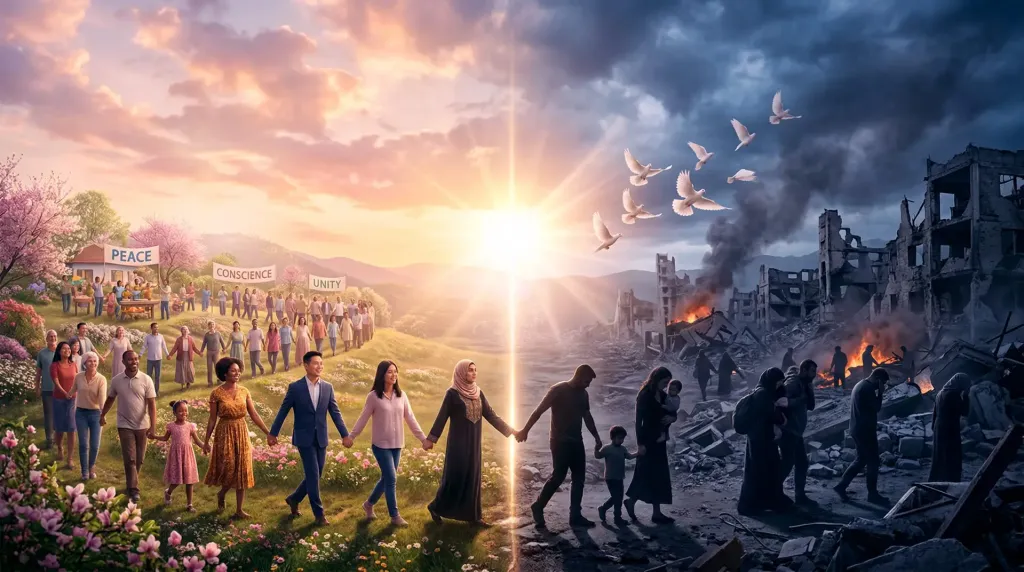
The Taheri Peace Organization names this year “The Year of Striving to Avert the Great Catastrophe,” holding onto the hope that, through every possible means, such a painful disaster may be prevented. In this regard, the organization honors the tireless efforts of the world’s enlightened people, those who seek to halt the continuation of war and strive to prevent humanity from reaching the final point of no return.
Furthermore, I must state that we have not yet reached the point where we can ask those who beat the drums of war—those who appealed to foreign powers to invade Iran and decimate its infrastructure, even offering them gratitude—where that promised liberty is, which they claimed would be achieved within days of an invasion. However, let them be prepared, for soon they must be held accountable and analyze the results and achievements of their actions, if only for themselves. My perspective was shared months ago, and all are aware of it; as predicted, events have unfolded as expected, proving that this war could never bring freedom to Iran. Just as a report on the invasion must be presented to the U.S. Congress on the 60th day to clarify its causes and objectives, those who championed the “gift of liberty” through foreign intervention must also answer to their compatriots: Where is that freedom? Moreover, they must answer for the global inflation and the shortages afflicting people across the world, particularly in the East—hardships that have embroiled all of humanity and are set to become even more calamitous in the days ahead.
Mohammad Ali Taheri
Founder of the Taheri Peace Organization & the Erfan Keyhani Halgheh School
Toronto: April 02, 2026 (Corresponding to Farvardin 13, 1405 SH)

